


Boost your performance under intense load
hyve L-Citrulline is a food supplement for endurance and strength athletes. It increases the availability of arginine for nitric oxide production and helps delay muscle fatigue during intense exertion
Better blood flow to the muscles

Higher tolerance of intense performance

Support for energy production under load

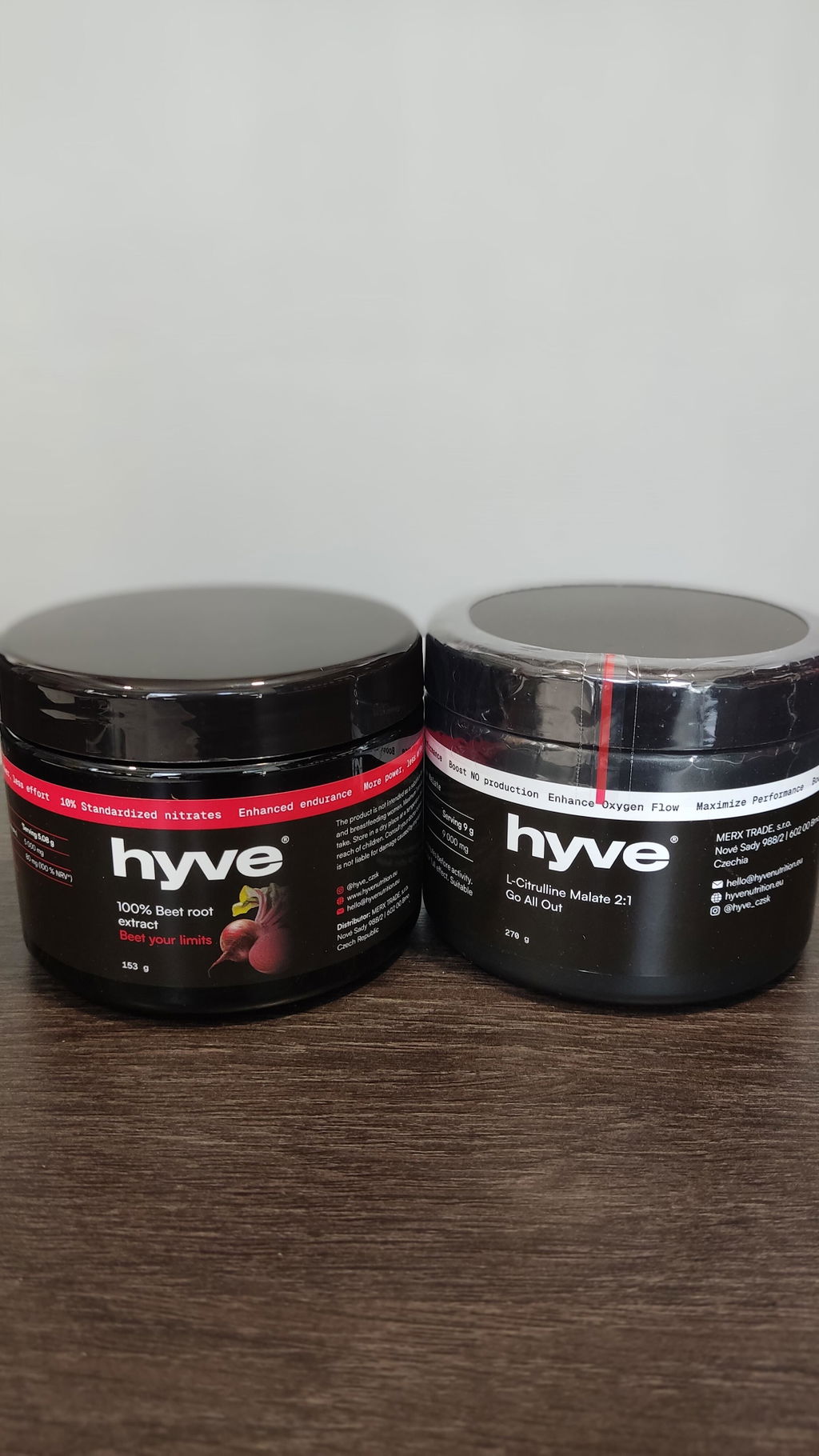
Combining L-citrulline with nitrates
The combination of L-citrulline and nitrates is an effective strategy for supporting sporting performance, because both substances increase the availability of nitric oxide (NO) in the body, each by a different metabolic route. L-citrulline raises the level of arginine in the blood, which is a direct precursor of NO, while the nitrate from beetroot is gradually converted in the body into nitrite and then into NO. Thanks to that, their combination supports even better blood flow to the muscles, more efficient transport of oxygen and nutrients and higher energy production during exercise than nitrates or L-citrulline on their own.

Longer without fatigue
During intense training, ammonia is produced in the muscles, which is associated with the feeling of fatigue and a drop in performance. L-citrulline is part of the urea cycle and helps the body remove this ammonia more efficiently. Thanks to this it can contribute to better tolerance of high intensity and to maintaining performance during demanding training.

100% L-citrulline Malate 2:1
L-citrulline is a precursor of arginine, which in the body serves as a key substrate for the production of nitric oxide (NO). Supplementing it raises plasma arginine levels more effectively than arginine itself, thereby supporting vasodilation (widening of the blood vessels) and improving the delivery of oxygen and nutrients to the working muscles. At the same time it helps to eliminate ammonia and delays muscle fatigue during intense endurance efforts, which leads to an increase in the power generated and a reduction in perceived effort
More information
hyve L-citrulline is not just another amino acid in the sports nutrition range. It is a scientifically supported tool for athletes who want to support blood flow, delay fatigue and improve the efficiency of muscular work during intense efforts.
Support for nitric oxide production for better blood flow
L-citrulline is a non-essential, non-proteinogenic amino acid that the body uses for the synthesis of arginine. It is from arginine that nitric oxide (NO) is then produced by the enzyme nitric oxide synthase.
Nitric oxide acts as a strong vasodilator – it widens the blood vessels and improves blood flow. Thanks to this, more oxygen and nutrients reach the working muscles, which can support both performance and recovery during demanding physical efforts.
A more efficient route to NO than arginine alone
L-citrulline is considered a more effective way of increasing the level of arginine in the blood than supplementing with L-arginine itself.
A large part of orally administered arginine is broken down already in the digestive tract and the liver by the action of the enzyme arginase. Citrulline avoids this metabolism and is subsequently converted into arginine in the body, which leads to a more pronounced increase in its plasma concentration. Studies also show that L-citrulline supplementation can increase the production of nitric oxide without gastrointestinal problems, even at doses of around 6 g per day.
Delaying fatigue thanks to the removal of ammonia
During intense exercise, ammonia is produced in the body – a metabolite that is associated with the onset of muscle fatigue.
Citrulline supplementation can support its more efficient removal via the urea cycle. Studies show that citrulline increases the plasma urea concentration and at the same time suppresses exercise-induced hyperammonaemia. Thanks to this, it can help to delay fatigue and maintain performance during prolonged efforts.
Support for endurance and performance at high intensity
Research suggests that regular citrulline supplementation can bring a measurable improvement in sports performance.
For example, seven days of supplementation with a dose of 6 g per day led to improved time-trial performance and a lower perceived exertion in trained cyclists. Other studies report improved performance in high-intensity exercise when citrulline was taken for approximately one week, with the last dose 1–2 hours before the effort.
Effectiveness depends on regular use
As with a number of other ergogenic substances, correct dosing and timing are key.
Most of the studies that demonstrated a positive effect on performance used chronic supplementation in the range of approximately 3.4–6 g of citrulline per day for at least 6 days. A single dose taken shortly before exercise, by contrast, usually did not lead to an immediate improvement in aerobic performance.
Based on the available data, the optimal strategy therefore appears to be daily supplementation with 6 g of citrulline for at least one week, with the last dose taken approximately 1–2 hours before training or a race.
Frequently asked questions
Get the most out of the productL-citrulline is a non-essential amino acid that is converted in the body into arginine – a substance used to produce nitric oxide (NO). Nitric oxide causes the blood vessels to widen (vasodilation), which can improve blood flow, the delivery of oxygen and nutrients to the working muscles and reduce the energy cost of muscle contraction. That can contribute to better endurance performance and faster recovery after exertion.
L-citrulline can slightly improve performance in high-intensity exercise thanks to increased production of nitric oxide (NO), which improves blood flow to the muscles and the delivery of oxygen and nutrients during exertion. It may be suitable for strength training with a higher number of repetitions, interval training or sports disciplines combining strength and endurance.
L-citrulline is usually dosed at 3–6 g a day, often for several days before an effort. In many studies athletes took 6 g a day for 7 days, with the last dose taken 1–2 hours before training or a race.
According to some analyses, short-term (acute) use only before an effort has a smaller effect or none at all, whereas supplementation over several days can improve performance more.
In practice:
- usual dose: 3–6 g a day
- length of supplementation: at least 6–16 days
- timing: last dose 1–2 hours before training
The effects of L-citrulline usually do not show up immediately. Research shows that the best results were observed after several days of regular supplementation, typically around 1 week of use (e.g. 6 g of pure L-citrulline a day or 9 g of L-citrulline Malate in a 2:1 ratio).
An acute dose 1–2 hours before training can raise the level of citrulline and arginine in the blood, but a single dose on its own often does not lead to a marked improvement in performance. A better effect was observed with supplementation lasting 6–16 days.
Yes, L-citrulline is generally considered a safe supplement when taken in the usual doses used in studies.
L-citrulline is a non-essential amino acid that the body is able to create on its own and that also occurs naturally in foods (for example in watermelon). After being taken it is largely converted into arginine and increases its concentration in the blood. Unlike direct supplementation with arginine, citrulline breaks down less in the digestive tract and the liver and does not cause the same gastrointestinal problems at comparable doses.
Studies commonly use doses of roughly 3–6 g a day for several days up to a week with no significant adverse effects reported.
Yes, L-citrulline can be combined with nitrates, this combination has synergistic effects, because both substances influence the production of nitric oxide (NO) in the body.
L-citrulline raises the level of arginine, which is the substrate for the enzyme nitric oxide synthase (NOS) and serves to produce NO. Nitrates, on the other hand, increase the availability of NO by a different route – the reduction of nitrate → nitrite → nitric oxide. Both mechanisms therefore lead to a higher availability of NO, which causes vasodilation, better blood flow and a better supply of oxygen to the muscles during exercise.
This combination of citrulline and nitrates strengthens NO signalling more than either substance on its own.
Yes! L-citrulline is suitable for women too. It works the same way in men and in women, because in the body it is converted into arginine and increases the production of nitric oxide (NO), which improves blood flow to the muscles and the delivery of oxygen and nutrients during exercise. That can support performance during intense training as well as recovery.
That is why it can be suitable for example for strength training, interval training or sports that combine strength and endurance.
Yes! L-citrulline can be taken by vegetarians and vegans without any problem. It is a non-essential amino acid that the human body is able to synthesise on its own and that also occurs naturally in some plant foods, for example in watermelon.
Because citrulline is commonly produced by fermentation processes, hyve L-citrulline does not come from animal sources.
L-citrulline, nitric oxide and sports performance
- Bescós, R., A. Sureda, J.A. Tur, and A. Pons. 2012. The effect of nitric-oxide-related supplements on human performance. Sports Med 42: 99-117.
- Schwedhelm, E., R. Maas, R. Freese, D. Jung, Z. Lukacs, A. Jambrecina, W. Spickler, F. Schulze, and R.H. Böger. 2008. Pharmacokinetic and pharmacodynamic properties of oral L-citrulline and L-arginine: Impact on nitric oxide metabolism. Br J Clin Pharmacol 65: 51-59.
- Aguayo, E. A. Martínez-Sánchez, B. Fernández- Lobato, and F. Alacid. 2021. L-citrulline: A non-essential amino acid with important roles in human health. Appl Sci 11:3293.
- Stanelle, S.T., K.L. McLaughlin, and S.F. Crouse. 2020. One week of L-citrulline supplementation improves performance in trained cyclists. J Strength Cond Res 34(3):647-652.
- Bailey, S.J., J.R. Blackwell, T. Lord, A. Vanhatalo, P.G. Winyard, and A.M. Jones. 2015. L-citrulline supplementation improves O2 uptake kinetics and high-intensity exercise performance in humans. J Appl Physiol 119(4):385-395.
- Viribay, A., J. Fernández-Landa, A. Castañeda-Babarro, P.S. Collado, D. Fernández-Lázaro, and J. Mielgo-Ayuso. 2022. Effects of citrulline supplementation on different aerobic exercise performance outcomes: A systematic review and meta-analysis. Nutrients 14(17):3479.
- Burgos J, Viribay A, Fernández-Lázaro D, Calleja-González J, González-Santos J, Mielgo-Ayuso J. Combined Effects of Citrulline Plus Nitrate-Rich Beetroot Extract Co-Supplementation on Maximal and Endurance-Strength and Aerobic Power in Trained Male Triathletes: A Randomized Double-Blind, Placebo-Controlled Trial.Nutrients. 2022;14(1):40.